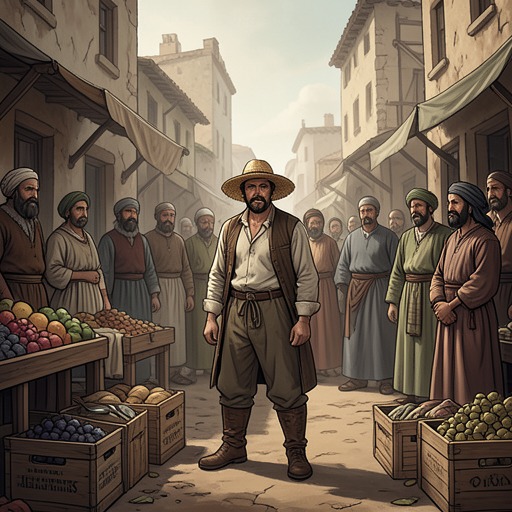
Compagnie Pordurière
Journey to the End of the NightCompagnie Pordurière is the colonial trading company that draws Ferdinand Bardamu into the commercial machinery of French colonial rule. Its work ranges from recruiting an inexperienced clerk for an isolated trading post to organizing labor in warehouses and plantations. The company offers advancement as a promise, but its daily operations depend on coercion, falsified measurements, and workers made interchangeable. Across Bardamu’s account, the company links colonial exploitation to the impersonal discipline he later encounters in an American factory.
Recruitment and the Trading Posts
In Africa, Bardamu hears that the Director of Compagnie Pordurière du Petit Congo needs an inexperienced man to manage a bush trading post. He applies without delay, describing his services as incompetent but enthusiastic. The Director questions him about his past and his medical studies before offering him work; Bardamu’s limited medical training is treated as useful, though his lack of experience is no obstacle to taking charge of a post. The exchange presents recruitment as an expedient response to the company’s need for staff, rather than as a search for expertise.
Bardamu is shown the unfinished shelter where he is temporarily to sleep, an empty shanty containing a few utensils and his folding bed. The company’s presence in the bush is thus represented not as secure settlement but as a precarious network of posts staffed by people sent into difficult conditions. The assignment gives Bardamu a position within the colonial enterprise, while its remoteness and improvised accommodation foreshadow the vulnerability of the clerks expected to serve it.
Labor and Colonial Administration
The company’s workforce includes African laborers and poor European employees. Bardamu describes African workers being driven to work with clubs, while the European workers are said to labor voluntarily, sustained by hopes of becoming rich and powerful. His contrast draws attention to different forms of compulsion: direct force on one side, and the promise of social and economic advancement on the other. In his account, neither arrangement amounts to meaningful freedom.
Before Bardamu can go to the bush, he must learn to number sacks in the company’s main warehouse. He works among crowded, poorly clothed laborers, while overseers strike them with clubs and the men continue without open protest. The task is not merely counting: the Director checks that Bardamu is learning how to number sacks and falsify weights. The company’s commercial routine therefore incorporates both the management of labor and the manipulation of what is recorded as its output.
The Director presents the company’s colonial order as a civilizing achievement. He recalls an earlier period of hunting and intertribal conflict, then celebrates the replacement of those practices with labor, peanuts, rubber, and taxation. In his account, the company has helped end tribal warfare; the practical result he emphasizes is a workforce and produce from which taxes can be collected. Bardamu’s surrounding description makes the rhetoric of progress inseparable from the conversion of people and land into sources of labor and revenue.
The Cost of Company Service
The company’s clerks are also expendable. Bardamu learns that Compagnie Pordurière loses dozens of small clerks each year at jungle trading posts near the swamps. Calling them pioneers does not make their losses less routine: the company consumes people like Bardamu as part of maintaining its outlying operations. His insecure status as a small employee contrasts with the Director’s authority and the organization’s continuing commercial demands.
That demand persists even when the company’s men are ill. Army and business representatives come to the hospital asking for their employees back, including men suffering from malaria or syphilis, because their units need them. The episode places company employment within a broader system that treats sick people as labor or personnel to be returned to service. In the colonial setting, institutions that might appear to offer care are pressed to restore workers to the demands of business and administration.
Echoes in Later Encounters
Years later, Robinson recalls that he and Bardamu had both known the company in Africa. Robinson’s recollections include stories about Compagnie Pordurière that he had not previously told Bardamu, who understands his companion as reticent and secretive. The shared employment becomes a point of reference between them, connecting their later lives to the same colonial past.
In a later social gathering, Robinson describes himself to an older man as the company’s chief agronomist, claiming that he mobilized a whole village to harvest crops. Bardamu recognizes these claims as fabricated memories: Robinson embellishes his experience to place himself on a level with a knowledgeable, well-connected guest. He tells the story with expansive gestures, presenting himself as a man of authority in the forests and plantations. The company’s name, once tied to low-paid service and hard labor, now supplies Robinson with material for self-invention.
Significance
Compagnie Pordurière is more than an employer in Bardamu’s African episodes. Its warehouse makes the organization’s labor system visible in concrete procedures: numbering sacks, falsifying weights, and using force to keep workers moving. At the same time, its outposts rely on clerks who are poorly protected and easily replaced. The company’s rhetoric of ending disorder and producing progress sits beside the extraction of rubber and peanuts, the collection of taxes, and the routine loss of employees.
The later references to Robinson extend the company’s significance beyond the period of employment. Its name remains available as a credential that can be exaggerated into a claim of expertise and status. In this way, Compagnie Pordurière connects colonial labor to the novel’s wider attention to class: the same institution that exploits workers becomes, in another setting, a resource for performing importance.